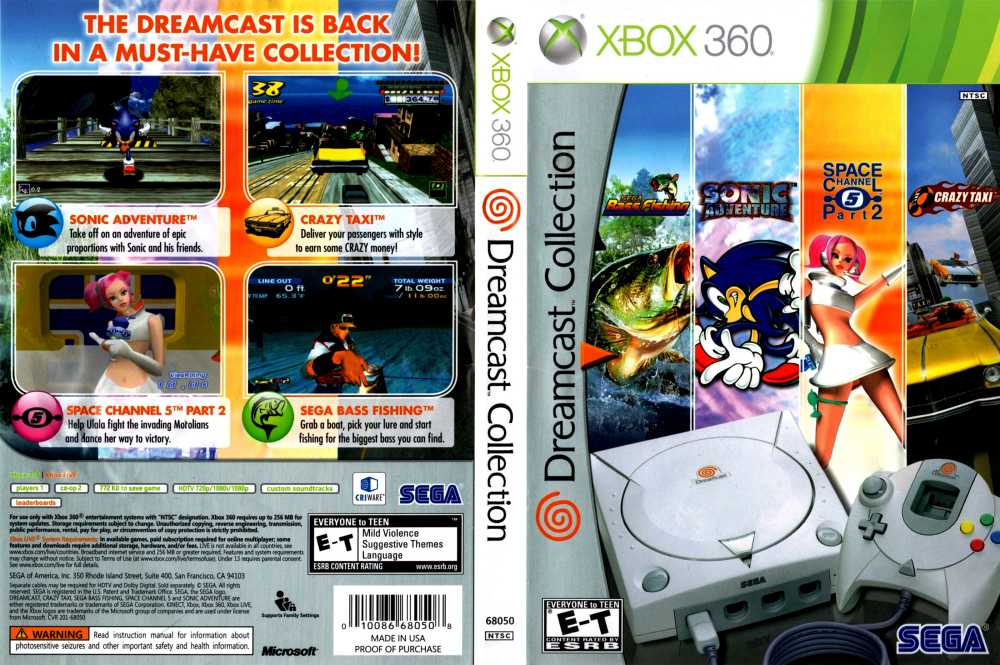


The Dreamcast, the last console from Sega and the first from Microsoft !
The Sega Dreamcast: Sega’s Last Console and Prelude to Microsoft’s Entry into the Console Market
The Sega Dreamcast represents a significant chapter in the history of video game consoles, serving as the final platform developed by Sega before its withdrawal from the hardware market in 2001. Launched in 1998 in Japan and in 1999 in North America and Europe, it introduced notable innovations, particularly in the realm of online gaming. Although Microsoft did not create or develop the Dreamcast—which remains a console designed by Sega—a close collaboration between the two companies integrated Microsoft technologies, such as Windows CE and elements of DirectX, facilitating the porting of PC games. This partnership laid the groundwork for Microsoft’s subsequent entry into the market with its first console, the Xbox, released in 2001. This article examines these historical aspects in a structured manner.
History and Innovations of the Sega Dreamcast
The Dreamcast was designed by Sega as a response to the growing competition from Sony with the PlayStation and Nintendo with the Nintendo 64. Equipped with a Hitachi SH-4 processor and a PowerVR GPU, it offered advanced graphics for its time, capable of displaying smooth and detailed 3D games. One of its primary innovations was its built-in support for online gaming via a 56K modem, enabling multiplayer experiences such as in Phantasy Star Online, considered one of the first MMORPGs on a console.
Despite these advancements, the Dreamcast faced commercial challenges. With approximately 9 million units sold worldwide, it suffered from a limited game library and the impending release of the more powerful PlayStation 2. Sega announced the cessation of production in March 2001, marking the end of its era as a console manufacturer and its shift toward software publishing.
Collaboration Between Sega and Microsoft: Integration of Windows CE and DirectX
Contrary to a common misconception, Microsoft did not develop the Dreamcast itself but collaborated with Sega to provide an optimized version of Windows CE as an optional operating system. Announced in 1998, this partnership aimed to create a familiar development environment for PC programmers by integrating the DirectX API and dynamic link libraries (DLLs). This facilitated the porting of Windows games to the console, leveraging tools such as Visual Studio and the adapted Windows CE SDK for the Dreamcast.
Windows CE offered features such as advanced 2D/3D effects, audio management, and support for input devices, making the platform more accessible to developers accustomed to the Microsoft ecosystem. Although not all Dreamcast games utilized Windows CE—some opting for Sega’s proprietary system—this integration eased the creation of titles like Quake III Arena and Unreal Tournament. This experience undoubtedly influenced Microsoft’s future strategy, though the Dreamcast was not a direct prototype of the Xbox.
The Xbox: Microsoft’s First Video Game Console
Building on its software expertise and collaboration with Sega, Microsoft launched its first dedicated console, the Xbox, in November 2001 in North America, followed by a worldwide release in 2002. Unlike the Dreamcast, the Xbox was entirely designed and produced by Microsoft, signifying its ambitious entry into the home console market. Equipped with an Intel Pentium III processor, an integrated hard drive, and support for online gaming via Xbox Live (launched in 2002), it aimed to compete with the PlayStation 2 and Nintendo’s GameCube.
The Xbox benefited from a PC-inspired architecture, with DirectX as its graphical foundation, simplifying the porting of games such as Halo: Combat Evolved, which became an iconic title. With over 24 million units sold, it established Microsoft as a major player in the industry, paving the way for future generations such as the Xbox 360 and beyond.
The Dreamcast: The Hidden “Prototype” of the Xbox?
In the history of video games, the Sega Dreamcast is often celebrated as the final machine from the Japanese giant, Sega. However, if you look under the hood, another truth emerges: this console, released in 1998 in Japan (1999 in the West), already carried the DNA of what would become the first Xbox.
Was it simply a Sega console, or was it actually Microsoft’s true Trojan horse to conquer the gamer’s living room?
1. Microsoft at the Heart of the System
For the first time in console history, a computer giant stamped its brand directly onto the front of a gaming machine. If you look closely at a Dreamcast case, you will often see the phrase: “Compatible with Windows CE”.
This was not merely a marketing partnership. Microsoft collaborated closely on the console’s development by providing an optimized version of its mobile operating system, Windows CE, integrating the DirectX API into a home console for the very first time.
Why this strategy?
The goal was to break down the barrier between the PC and the console. By using Dynamic Link Libraries (DLLs) and DirectX, Microsoft offered developers a familiar environment.
Easy Porting: A game developed on PC could be transferred to the Dreamcast with ease.
Standardization: This allowed cult PC titles to emerge on the console (such as Rainbow Six or Worms Armageddon).
2. The First Connected Console: An American Bet
You are right to highlight the pioneering nature of the network capabilities. The Dreamcast was the first console shipped with a built-in 33k (later 56k) modem as standard.
This vision of “online gaming for everyone” (with the SegaNet service) was heavily aligned with the internet strategy Microsoft was beginning to deploy. Although the infrastructure was managed by Sega, the user experience and the “online” philosophy served as a real-life lesson for Microsoft.
Did you know? It was this online gaming experience on the Dreamcast that laid the conceptual foundations for the future Xbox Live, the service that would drive the Xbox’s success two years later.
3. From Dreamcast to Xbox: The Transition
While the Dreamcast was not manufactured by Microsoft, it undeniably served as a “commercial prototype” for Bill Gates’ company. When Sega announced its withdrawal from the console market in 2001, Microsoft literally replaced Sega in the hearts of “hardcore gamers.”
The similarities are striking:
The Controller: The controller of the first Xbox (the “Duke”) looks strangely like a muscular version of the Dreamcast controller (memory card slots, stick layout).
The Games: Many games planned for the Dreamcast ended their lives on Xbox (such as Shenmue II or Jet Set Radio Future).
The Key Man: Peter Moore, President of Sega of America during the Dreamcast launch, later became… the Vice President of the Xbox division at Microsoft!
Conclusion: The Legacy
To say that the Dreamcast was a prototype for the Xbox is not far from the historical truth. Microsoft used this generation to test its tools (DirectX/Windows CE) and observe the market.
The Dreamcast was the laboratory; the Xbox was the finished product. When the Dreamcast faded away, its soul and technology continued to live on through Microsoft’s black console. It was much more than a collaboration: it was a passing of the torch.
The Sega Dreamcast, while leaving a mark on history through its innovations in online gaming and technological collaboration with Microsoft, illustrates the challenges of a competitive market.
This partnership not only enriched Sega’s platform but also prepared the ground for the Xbox, Microsoft’s first successful foray into video game consoles.
These developments highlight the rapid evolution of the industry, where strategic alliances play a key role in innovation and competition.#AdilZaghdoud
Source by Adil Zaghdoud